

NextGen Geotechnics
Geo-CARE Webinar Series
An open series on emerging research, innovative methods, and sustainable practice shaping the future of geotechnical and geoenvironmental engineering. Sessions run online and are free to attend.
The series so far
A global classroom for geotechnical engineering
Where our participants join from
Who joins
36% of participants are students.
Spring 2026 4 sessions
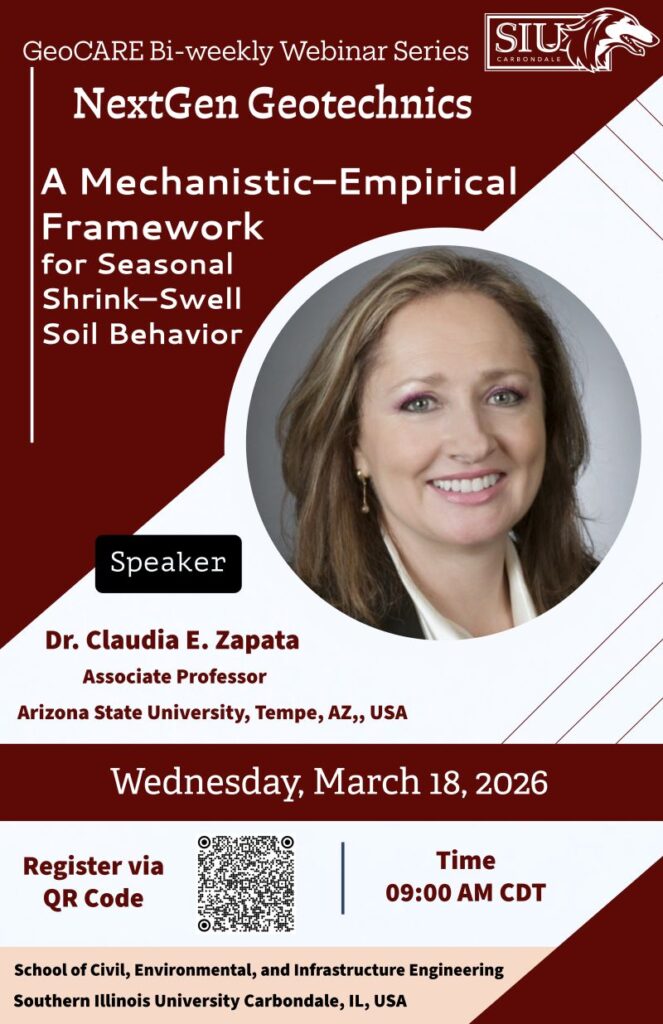
Wednesday, March 18, 20269:00 AM CDT
A Mechanistic–Empirical Framework for Seasonal Shrink–Swell Soil Behavior
Dr. Claudia E. ZapataAssociate Professor, Arizona State University, Tempe, AZ
73 registered19 countries
Accurately predicting time-dependent volume change in shrink–swell soils is critical for the design and forensic evaluation of shallow foundations and pavements. This talk presented an improved mechanistic–empirical framework for estimating soil volume change under seasonally varying climatic conditions.
Building on prior models by Lytton et al. (2005), Vann and Houston (2021), and Olaiz et al. (2021), the framework incorporates updated representations of short-term climate variability. Predictions were demonstrated using data from the AASHTO Long-Term Pavement Performance Seasonal Monitoring Program in north Texas and compared against field measurements, showing promising agreement. The framework is adaptable worldwide with appropriate local calibration.
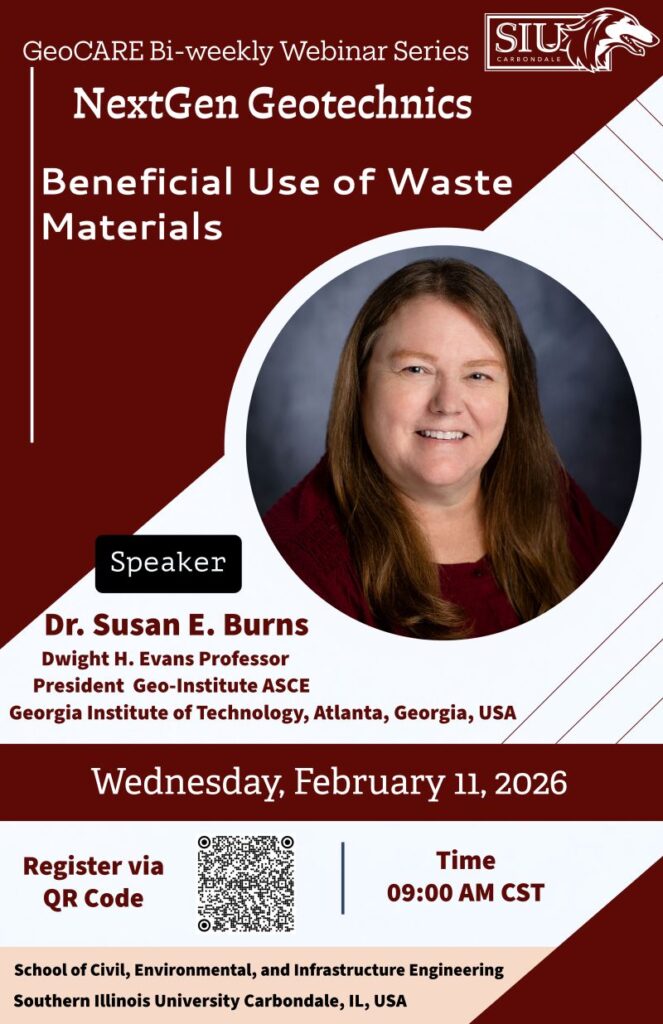
Wednesday, February 11, 20269:00 AM CST
Beneficial Use of Waste Materials
Dr. Susan E. BurnsDwight H. Evans Professor · President, Geo-Institute of ASCE, Georgia Institute of Technology, Atlanta, GA
86 registered17 countries
The engineering behaviour of weathered deposits of off-specification fly ash produced through coal combustion for power generation.
The talk addressed reclamation and beneficial use of high organic content and ponded ash as a supplementary cementitious material in concrete, against the backdrop of recent market shortages. Trends in chemical, morphological, and mechanical properties were analysed as a function of storage conditions, with recommendations for field application in construction materials.
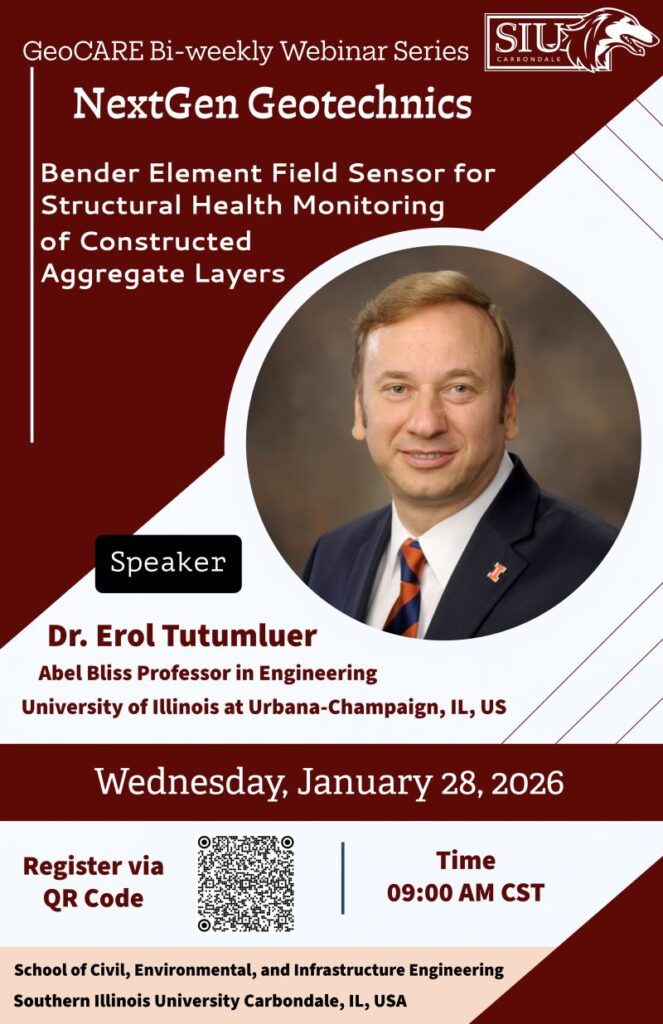
Wednesday, January 28, 20269:00 AM CST
Bender Element Field Sensor for Structural Health Monitoring of Constructed Aggregate Layers
Dr. Erol TutumluerAbel Bliss Professor in Engineering, University of Illinois Urbana-Champaign
95 registered17 countries
The development and field deployment of a bender element shear wave transducer that assesses the in-situ modulus of constructed base and subbase layers through elastic wave velocity measurements.
Dr. Tutumluer discussed instrumentation procedures and the refinement of bender element field sensors across several full-scale pavement test sections:
The session highlighted how these measurements reveal layer modulus evolution during construction, including confinement effects and locked-in residual stress development in aggregate layers.
- Smart Runway airport pavement section, Hill Air Force Base, Utah
- FAA National Airport Pavement Test Facility, New Jersey
- FHWA highway pavement test sections, Virginia
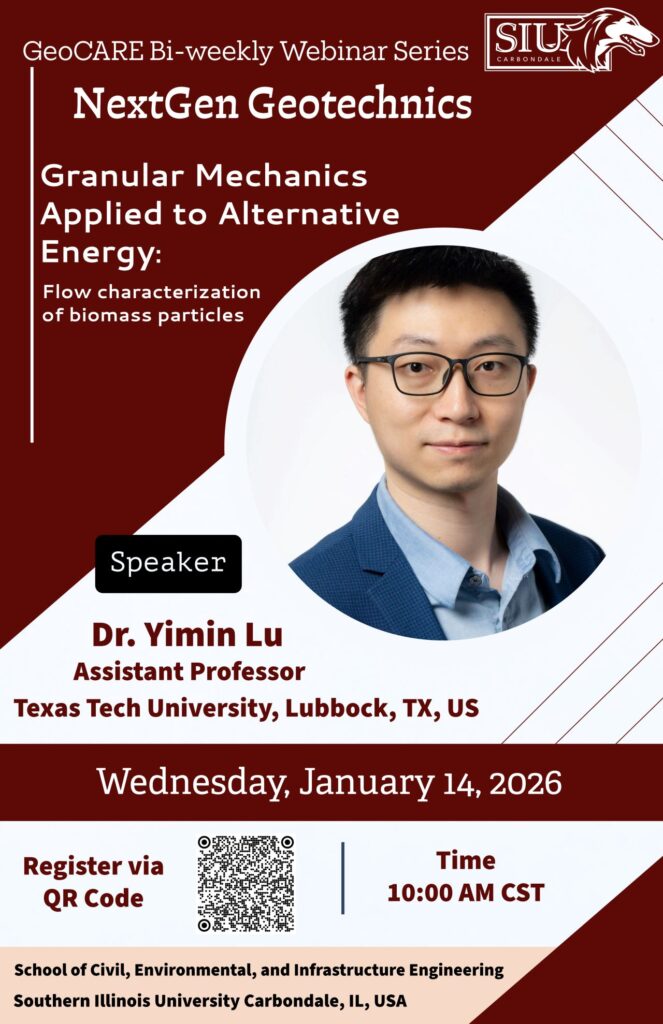
Wednesday, January 14, 202610:00 AM CST
Granular Mechanics Applied to Alternative Energy: Flow Characterization of Biomass Particles
Dr. Yimin LuAssistant Professor, Texas Tech University, Lubbock, TX
73 registered15 countries
The opening session of the series, on the flow behaviour of biomass particles and what granular mechanics contributes to alternative energy systems.
NextGen Geotechnics focuses on emerging research, innovative methods, and sustainable practices shaping the future of geotechnical and geoenvironmental engineering.
Spring 2025 · Civil Engineering for the Future 2 sessions
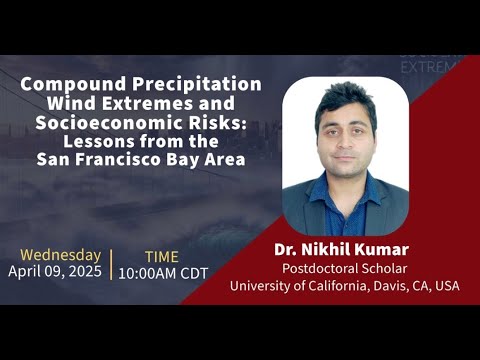
Wednesday, April 9, 202510:00 AM CDT
Compound Precipitation Wind Extremes and Socioeconomic Risks: Lessons from the San Francisco Area
Dr. Nikhil KumarPostdoctoral Scholar, University of California, Davis, CA, USA
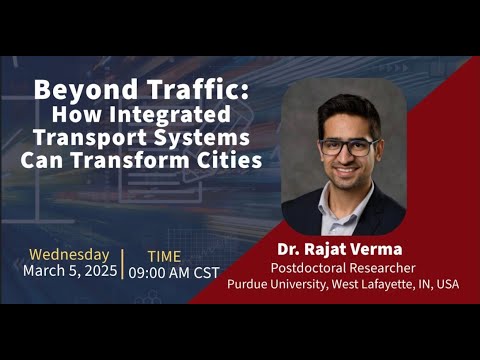
Wednesday, March 5, 20259:00 AM CST
Beyond Traffic: How Integrated Transport Systems Can Transform Cities
Dr. Rajat VermaPostdoctoral Researcher, Purdue University, West Lafayette, IN, USA
Fall 2024 · Civil Engineering for the Future 1 session
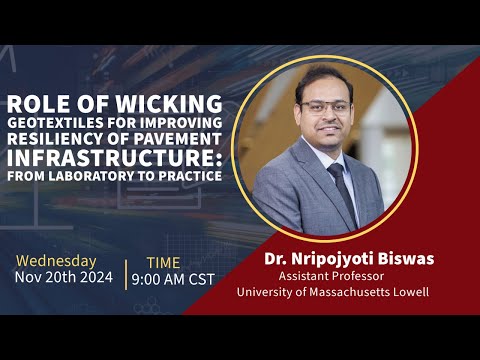
Wednesday, November 20, 20249:00 AM CST
Role of Wicking Geotextiles for Improving Resiliency of Pavement Infrastructure
Dr. Nripojyoti BiswasAssistant Professor, University of Massachusetts Lowell, MA, USA
