

Webinar Registration
Live onlineNextGen Geotechnics Webinar Series
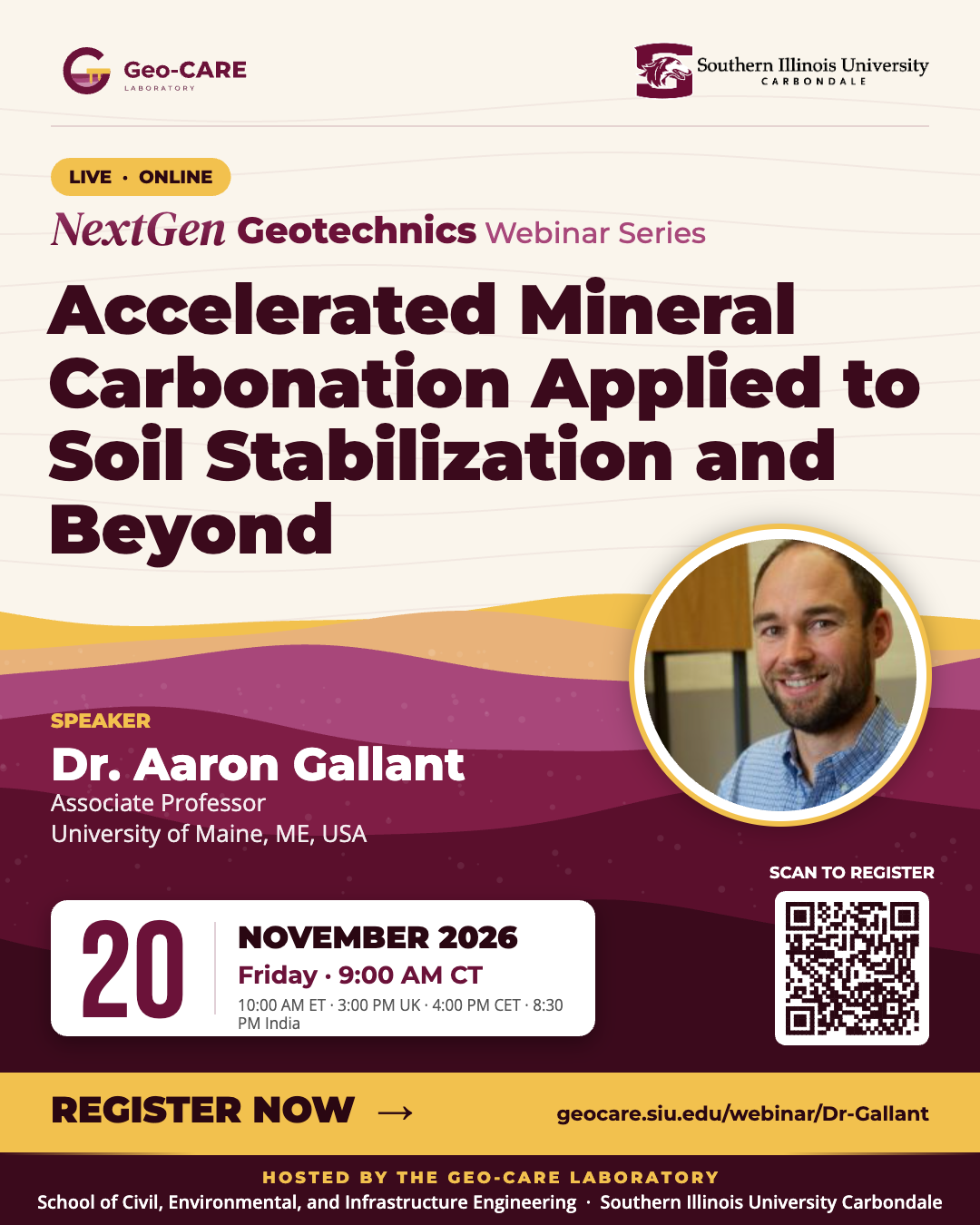
Accelerated Mineral Carbonation Applied to Soil Stabilization and Beyond
Register nowOnline · open to all · certificate and 1.0 PDH on request
About the talk
Conventional soil stabilization methods often rely on cementitious binders whose production contributes substantially to greenhouse gas emissions. Accelerated mineral carbonation (AMC) offers an alternative approach in which alkaline materials react with carbon dioxide (CO₂) to form carbonate minerals that cement soil particles together, potentially improving engineering performance while reducing the carbon footprint of ground improvement. This presentation will introduce the fundamental reactions underlying AMC and summarize experimental research conducted at the University of Maine to evaluate its application to soil stabilization. Laboratory investigations examining the effects of soil composition, moisture conditions, binder content, and CO₂ delivery on carbonation and the resulting engineering properties of treated soils will be discussed. Particular attention will be given to the mechanisms controlling carbonation, improvements in soil strength and stiffness, and challenges associated with scaling the technology toward field implementation. Discussion of the potential impacts on green house gas emissions and opportunities to apply the technology beyond conventional soil stabilization will also be discussed.
About the speaker
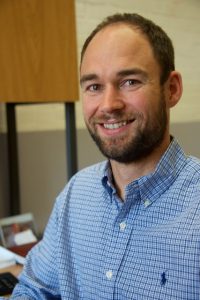
Dr. Aaron GallantAssociate Professor, University of Maine, ME, USA
Aaron Gallant, Ph.D., P.E., is an Associate Professor of Civil and Environmental Engineering at the University of Maine. His research focuses on geotechnical soil stabilization and ground improvement, including accelerated mineral carbonation for soil stabilization. His work combines laboratory experimentation, field investigations, and analytical and numerical modeling to better understand and improve the engineering behavior of geomaterials. He has led research projects supported by federal and state agencies and industry partners. Prior to joining the University of Maine, Dr. Gallant worked as a practicing geotechnical engineer at CH2M Hill.
ProfileLinkedInShare this webinar
Hosted by the Geo-CARE Laboratory, School of Civil, Environmental, and Infrastructure Engineering, Southern Illinois University Carbondale. All webinars and recordings
Never miss a webinar. Add all upcoming sessions to your calendar: Outlook or Apple Calendar · Google Calendar.
Privacy. We use your details only for this webinar series (joining link, reminders, certificate and, if you agree, future announcements). To see or delete what we hold about you, email nitin.tiwari@siu.edu.
Professional Development Hours (PDH) are self-reported; each licensing board decides what it accepts. The Geo-CARE Laboratory is not an NYSED-approved sponsor.
