

Webinar Registration
Live onlineNextGen Geotechnics Webinar Series
Multiscale Experimental Insight of Dynamic Soil Properties
Register nowOnline · open to all · certificate and 1.0 PDH on request
About the talk
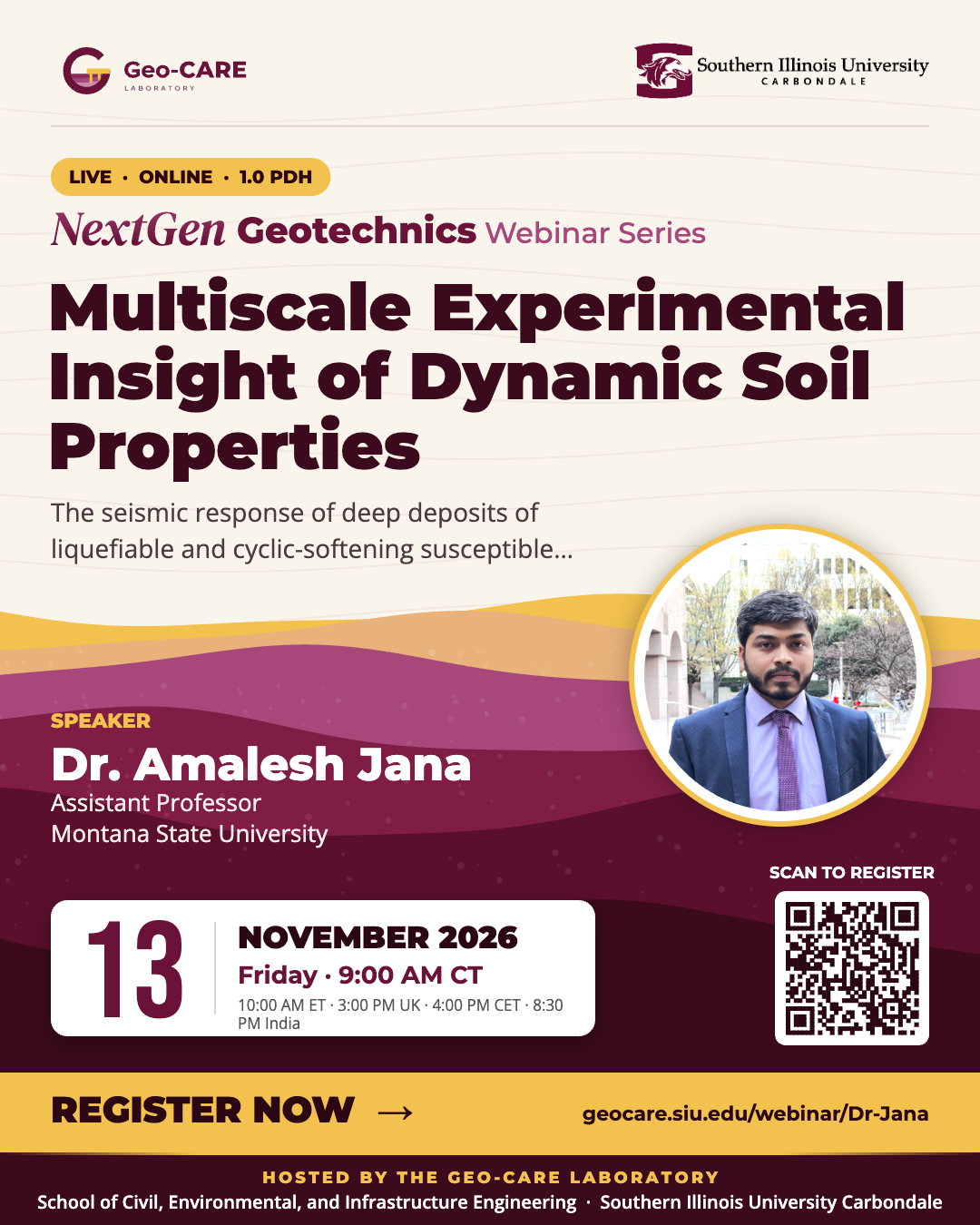
The seismic response of deep deposits of liquefiable and cyclic-softening susceptible soils has presented the geotechnical profession with significant challenges ranging from the assessment of site response and the evolution of amplification during earthquakes. The strong ground motion may soften soils under cyclic shear, trigger liquefaction, and produce damaging displacements as a consequence. Robust determination of constitutive model parameters that can be used in numerical deformation analysis to predict soil response under dynamic loading is important, yet observations of the in-situ dynamic soil response are scarce. As a result, significant engineering judgment is often required over the course of such investigations. Although numerous laboratory studies on reconstituted and natural soil specimens have been performed to aid the understanding of general trends in dynamic response, the former cannot capture the effects of aging, soil fabric, and deposition-induced anisotropy, and the latter is frequently affected by sample disturbance and/or disturbance during specimen preparation. Testing of natural soil deposits in their in-situ state facilitates the assessment of seismic performance using large volumes of soil in an undisturbed manner and under natural drainage conditions. This presentation will provide (1) an overview of a development of a new in-situ field testing method to obtain the dynamic properties of soil deposits in-situ at any depth, (2) improve the understanding of the in-situ coupled, cyclic shear and strain-induced excess pore pressure and nonlinearity of soil, and (3) compare the in-situ dynamic soil response derived from two different field-testing techniques. Side-by-side evaluation of the in-situ and laboratory element test responses further bridges the gap between the dynamic performance of large volumes of soil and small laboratory-scale specimens subjected to idealized boundary conditions, which advance our understanding of hazards associated with earthquakes and the potential impacts on critical infrastructure.
About the speaker

Dr. Amalesh JanaAssistant Professor, Montana State University
Amalesh Jana is an Assistant Professor at Montana State University. His research focuses on advanced geotechnical laboratory testing, designing instrumentation for novel large-scale field experiments, and developing an analytical and numerical model to support and inform the interpretation of the field responses. He has participated in several collaborative research projects with university and industry partners to address various pressing concerns in the field of resilient civil infrastructure. He believes the use of new technology, collaborations, and multi-disciplinary research will significantly affect the new millennium of civil engineering.
ProfileLinkedInShare this webinar
Hosted by the Geo-CARE Laboratory, School of Civil, Environmental, and Infrastructure Engineering, Southern Illinois University Carbondale. All webinars and recordings
Never miss a webinar. Add all upcoming sessions to your calendar: Outlook or Apple Calendar · Google Calendar.
Privacy. We use your details only for this webinar series (joining link, reminders, certificate and, if you agree, future announcements). To see or delete what we hold about you, email nitin.tiwari@siu.edu.
Professional Development Hours (PDH) are self-reported; each licensing board decides what it accepts. The Geo-CARE Laboratory is not an NYSED-approved sponsor.
